
Mantodea, the order of insects commonly known as the Praying Mantis, includes more than 2,400 colorful, unique and fascinating species that have adapted to thrive in habitats across the globe, no matter whether they are tropical rainforests, arid deserts, temperate grasslands or even suburban gardens. These patient, focused predators have evolved a remarkably dynamic array of physical forms and behaviors. Read on to learn how mantises hunt, camouflage themselves, reproduce, and survive in such diverse environments!
Odds are, if its a biome, the mighty mantis has found a home to thrive! Take a look at the helpful chart below to see what regions are an ecosystem for the mantis, and what unique adaptations they have evolved in order to survive!
|
Region |
Dominant Environments |
Notable Adaptations |
|
Africa |
Rainforest, savanna, scrub, desert margins |
Leaf mimicry, flower mimicry, arid adaptations |
|
Asia |
Tropical forest, farmland, temperate forest |
Flower mimicry, large-bodied species, seasonal tolerance |
|
Europe |
Mediterranean scrub, grassland, woodland edges |
Heat tolerance, open-habitat camouflage |
|
North America |
Grassland, woodland, gardens, agricultural land |
Seasonal survival, generalist hunting |
|
Central/South America |
Rainforest, cloud forest, savanna |
Extreme camouflage specialization |
|
Australia |
Tropical forest, woodland, grassland, arid zones |
Bark, twig, flower, and ground camouflage |
|
Middle East/Central Asia |
Desert, semi-desert, wadis |
Heat and drought tolerance, open-ground hunting |
A massive continent, Africa is filled with a wide variety of ecosystems and climates. Africa's climate range includes equatorial rainforests, humid coastal belts, arid deserts and cool southern highlands. Each of these has helped the mighty Mantis to specialize in distinctive ways.
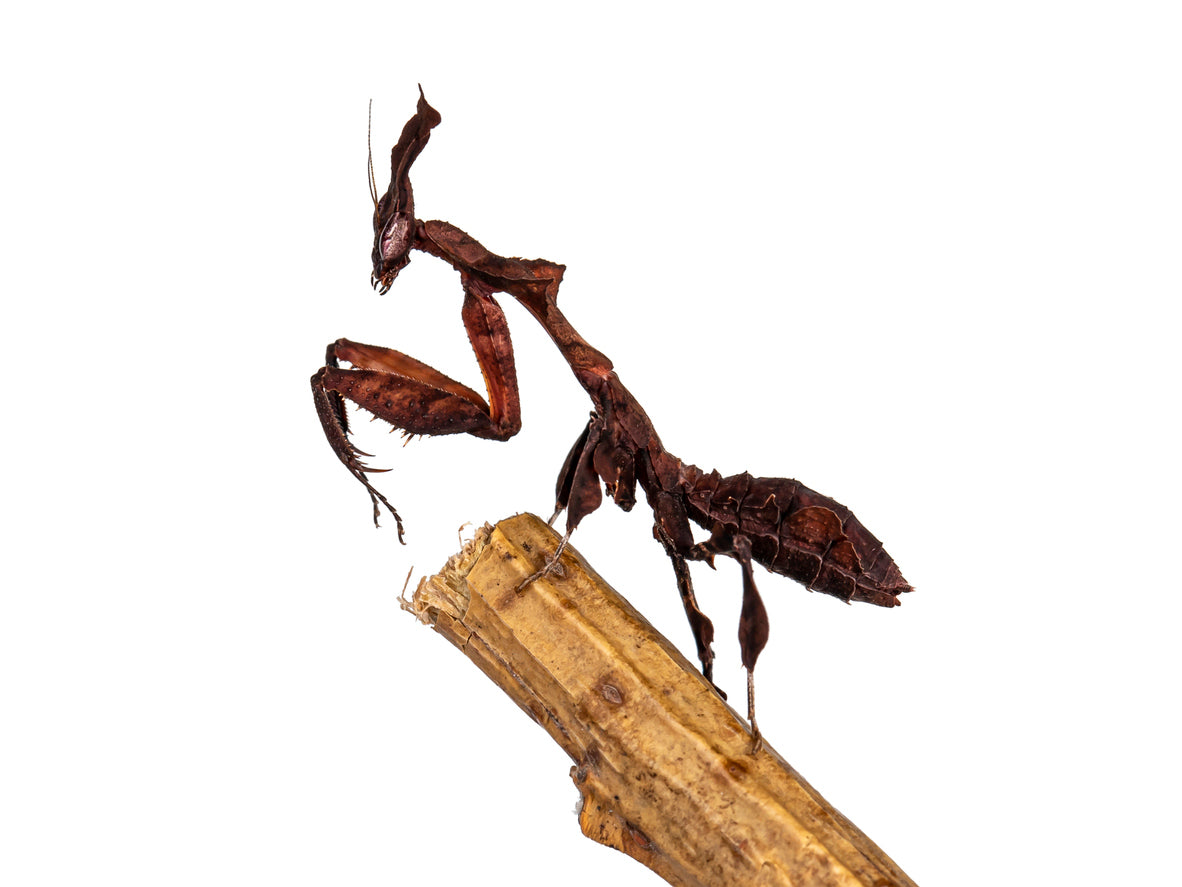
The Ghost Mantis (Phyllocrania paradoxa) is native to Africa (including Madagascar). This species loves warm, dry scrubland and the shrubby vegetation that thrives within it. Its body has the uncanny ability to mimic a dead, curled leaf, with a head crest, leaflike leg joints, and mottled brown colors that let it hang motionless among withered foliage. This camouflage suits seasonal habitats prone to drought where dead leaves are common.
The Egyptian Flower Mantis (Blepharopsis mendica) (also called the thistle mantis) is native to North Africa and parts of the Middle East, ranging from Egypt across arid regions into the Arabian peninsula. It thrives in hot, dry deserts and scrubland. Its pale, waxy body and flattened, petal-like legs blend with dry flowers and thistles. When threatened, it spreads its wings in a bold, eye-spotted display to ward off potential predators!
Asia's vast range of climates, from equatorial rainforests to subtropical monsoon belts and cool temperate steppes, has given a myriad of mantis species the ability to specialize in many different ways - skills and behaviors that are needed to survive in countless biomes filled with threats.
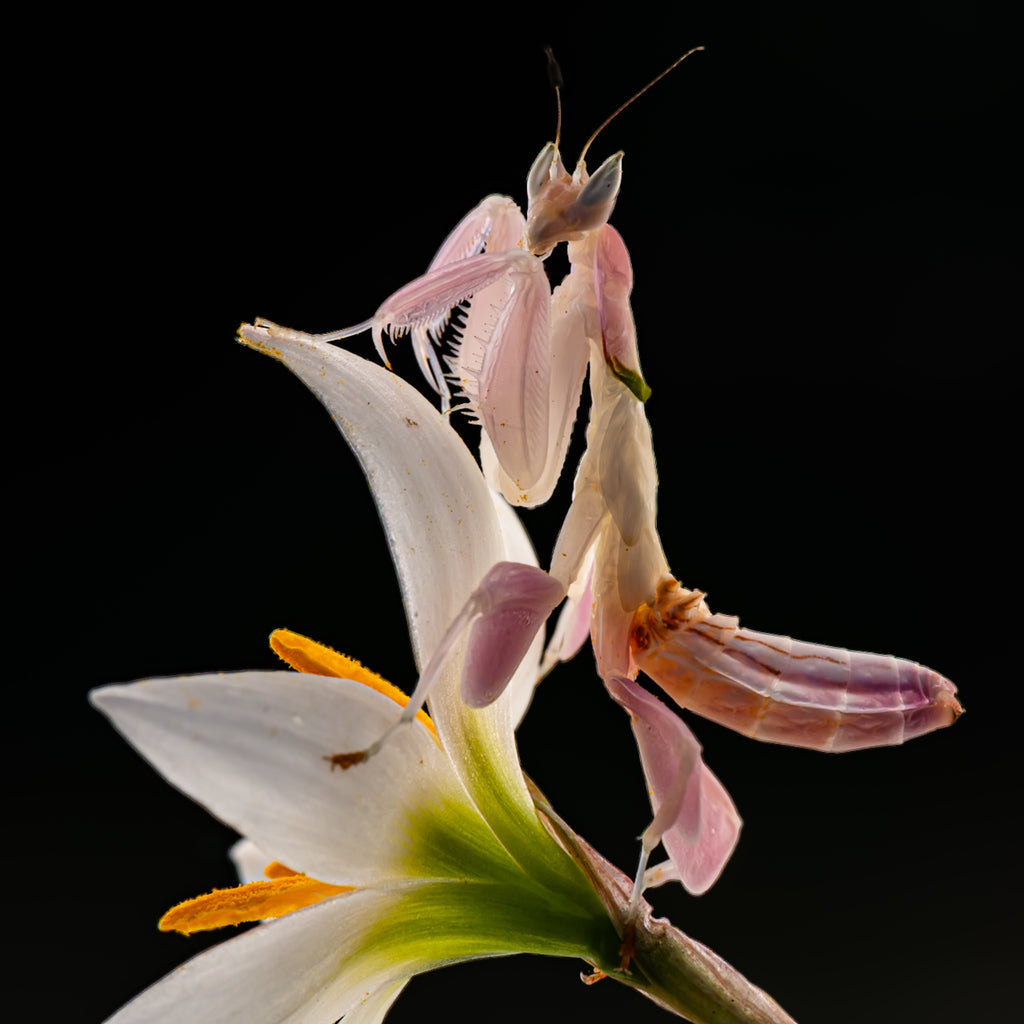
This fascinating bug looks more like a Star Wars creature than an animal native to Earth! The orchid mantis (Hymenopus coronatus) is native to the tropical rainforests of Southeast Asia, including Malaysia, Indonesia, Thailand, and Vietnam. It prefers warm, humid conditions and dense flowering vegetation. Its white and pink body and petal-shaped legs mimic colorful local blossoms, giving it a powerful camouflage as it wait motionless on flowers. Insects visiting the blooms often mistake it for a flower, and it can shift its coloring gradually to match its surroundings.
The Chinese mantis (Tenodera sinensis) is native to China and neighboring parts of East Asia, including Korea and Japan, and has been introduced into North America. It occupies temperate grasslands, meadows, and shrubby fields. Its green-to-brown coloring blends with grasses and stems. Females lay foam-like egg cases on plants that insulate the eggs through cold winters, which strictly ties the species to seasonal, temperate climates, in contrast to the flexible reproductive habits of other species.

Time to turn our attention to the west! Europe's climate is largely temperate, but it also includes warm Mediterranean subtropical coasts and cooler continental interiors with forests and plains. Europe has no true tropical zones, so vivid rainforest flower mimics like the ones in Asia are absent. Instead, the sun-baked Mediterranean is home to species like the European mantis. Let's learn more about him below!
The European mantis (Mantis religiosa) is native to parts of Europe, Africa, and Asia, inhabiting grasslands, meadows, shrublands, and other warm, open environments. Its green or brown coloration provides effective camouflage among vegetation, helping it ambush prey and avoid predators. Adapted to temperate climates, it thrives in warm conditions and uses surrounding plants for concealment, hunting, and shelter. This species is one of the most common types to find in the wilds of Europe!
The conehead mantis (Empusa pennata) is native to the Mediterranean region, including southern Europe and parts of North Africa. It inhabits dry grasslands, scrublands, and sunny, sparsely vegetated areas primarily along the coastline. It has an incredibly unique elongated body, pointed head, and leaflike appendages that provide remarkable camouflage among grasses and twigs, akin to that of a stick bug. Specialized for warm, dry environments, this mantis relies on stillness and cryptic coloration to ambush prey while avoiding detection by bigger predators.
North America’s diverse climates, spanning tropical regions in the south to temperate forests and cooler northern zones, support a variety of mantis species with distinct adaptations. In warmer areas, species such as the bordered mantis (Stagmomantis limbata) blend into flowering plants and shrubs to ambush prey. Farther north, cold-tolerant species survive seasonal temperature changes through behavioral adjustments and seasonal life cycles, altering reproductive strategies to survive the cold. This environmental diversity allows mantis species to specialize in different habitats, camouflage strategies, and hunting techniques.
The Carolina mantis (Stagmomantis carolina) is native to the southeastern United States and other parts of North America, ranging through grasslands, gardens, agricultural fields, and open woodlands. True to its name, it is commonly found in North and South Carolina! Its coloration varies from green to brown or gray, helping it blend into surrounding vegetation. Well adapted to warm climates, this species relies on camouflage and patient ambush hunting to capture insects while still taking the time to relax in the sunlight.
G'day! Australia’s diverse climates, ranging from tropical coastal regions to extremely hot and inhospitable central zones, support a variety of mantis species adapted to distinct habitats. In warmer areas, flower-mimicking species such as the Orchid Mantis succeed through their unique floral ambush strategies, while native Australian mantises use leaflike or bark-colored camouflage in grasslands, forests, gardens and shrublands. Species inhabiting cooler regions must also tolerate seasonal temperature changes, with life cycles and sheltered microhabitats helping them persist across Australia’s varied and often hostile environments.
The garden mantis (Orthodera ministralis) is native to Australia along with New Zealand, where it inhabits gardens, grasslands, shrublands, and open woodland. Their bright green coloration helps them blend into leaves and stems, providing concealment while hunting insects. Adapted to warm environments, this species often rests among vegetation, using camouflage and stillness to ambush prey while remaining less noticeable to potential predators. This scrappy little mantis grows to a length of up to 4 centimeters long, with distinctive blue-to-purple spots along the inside of its front legs.
The purple-winged mantis (Tenodera australasiae) is native to parts of South and Southeast Asia, extending into northern Australia and other tropical and subtropical regions. It inhabits grasslands, scrub, and agricultural areas, where its green or brown body helps it blend into the dry and often dusty surrounding vegetation. Its long wings support sustained flight between suitable habitats, a must in areas where flash floods or fires can occur. These long wings are also excellent tools for ambush-hunting behavior.
The circus is in town! Also known as the Rainbow Mantis, the Clown Mantis is a colorful northern woodland species known for vibrant patterns and distinctive red markings around the mouth, like a clown's makeup. This mantis makes its home in dry grasslands, arid forests, shrubland and the vast savannahs that make up 25% of the continent.
Did you know that Australia has rainforests? This impressive mantis is one of the largest Praying Mantis species in the world, and makes it's home in the coastal rainforests along the edges of the continent! The Giant Rainforest Mantis is usually a green color, though it exhibits fascinating variety with occasional brown, golden-yellow and even orange coloring. This Mantis is a stunning 7–11 cm (2.8–4.3 in) in total length from head to wingtip. The word "majuscula" means 'large' in Latin, a fitting title for such a big bug!
Central and South America is a vast range of land and biomes, and offers a suitably eclectic mix of mantis species. Central and South America span tropical rainforests, subtropical woodlands, grasslands, and cooler highland regions, creating diverse habitats for these skilled and clever bugs. In tropical environments, flower-mimicking mantises use colorful bodies and petal-like structures to attract or ambush insect prey, while leaflike species disappear into dense vegetation. Let's peer through the leaves to get a closer look at these incredible insects!

What's under the hood? The Hooded Mantis is a strikingly unique insect with an obvious physical characteristic that sets it apart from all other mantis species: a wide, expanded leaflike "pronotum" (also known as a prothorax), the upper plate-like surface of the insect thorax. As you can imagine, this provides perfect camouflage for hiding among leaves and waiting to strike any prey passerby. The Hooded Mantis is native to Central America and parts of northern South America, inhabiting tropical rainforests and humid woodland environments.
The Bark Mantis (Liturgusa ) is native to tropical Central and South America, where it inhabits the nooks and crannies of rainforest tree trunks and branches. Its flattened body and mottled brown, gray, or barklike coloring help it blend seamlessly into tree surfaces. Unlike the ambush habitats of other mantis species, bark mantises are agile runners that dart around trunks to both escape threats and pursue prey. Their camouflage and speed make them particularly well suited to a stealthy life on tree bark.
The Middle East and Central Asia encompass arid deserts, subtropical hinterlands, grasslands and scrublands, and temperate mountain regions, creating varied habitats for mantis species that range across both massive areas.
The Desert Ground Mantis (Eremiaphila ) is native to arid regions of North Africa, the Middle East, and parts of Central Asia, where it inhabits sandy deserts and harsh rocky landscapes. Since there is no greenery around, it uses its flattened body and sandy coloration to provide camouflage against the ground, helping it avoid predators and approach prey completely unnoticed.
Adapted to hot, dry environments, this ground-dwelling mantis stays low and moves quickly across open terrain, often seeking shelter beneath rocks or sparse dry vegetation during extreme heat. Their lives are spent so close to the ground that they don't even have wings!
We mentioned the Conehead Mantis earlier, but this species is also found throughout the Middle East, Western Asia and North Africa, primarily on the coast with the Mediterranean or Black sea. This unique little fellow thrives in warm, dry areas such as sunny karst slopes, rocky scrublands, dry bushy pastures, and woodland edges with low vegetation. Like it's European counterpart, it has a distinct tapering "cone-shaped" head, with large oval eyes.
Now that we've studied a multitude of our mantis friends, it's easy to realize what a diverse and profoundly unique insect the Praying Mantis is, with so many incredible variations across our planet! From tropical rainforests to arid deserts and temperate grasslands, mantises around the world reveal insect capacity to adapt to their environments through clever camouflage, specialized hunting strategies, and flexible habitat preferences.
By exploring these remarkable differences, we can help growing minds connect diverse biology with real-world ecosystems and what that means through future study and conservation of our beautiful natural world. Through hands-on insect activities and STEM exploration, kids can observe adaptations firsthand, ask scientific questions, and develop a deeper understanding of biodiversity, evolution, and the incredible living universe around us!
Mark your calendars! Our Insect Lore Praying Mantis kits are currently out of stock, but will be available this December! Visit us today to view our available insect kits and products that will provide endless hours of fun, learning and exploration for both home and classroom education. By observing live insect life cycles through hands-on learning experiences, children can develop a deeper understanding of biology, adaptation, and ecosystems. These habitat kits encourage curiosity, strengthen scientific observation skills, and build foundational STEM concepts - all while giving families and educators like the meaningful opportunities to turn everyday discoveries into beloved learning experiences. Be sure to check out our Rewards program to see how you can benefit from being a valued customer!

In this article, you'll learn about mantis anatomy, hunting strategies, life cycles, and how to identify common species you might encounter on your outdoor travels.

The Praying Mantis may be tiny, but there's more to these insects than meets the eye! in a dangerous wild world filled with hungry predators, the mantis needs to use every tool at it's disposal to survive and thrive! Read on to discover how the Praying Mantis uses a unique and powerful system of mechanisms to make its way in nature.

In this article, you’ll discover the meanings and beliefs associated with the praying mantis across different cultures. You won't believe what you'll discover!

Our insects are sensitive to outdoor temperatures. We recommend ordering when daytime temperatures are below 90 degrees.
We are unable to combine redemption fees. If you are redeeming 1-5 voucher codes, please complete separate purchases through our website for each voucher. If you are redeeming 6+ vouchers, please email us at customerservice@insectlore.com with your voucher codes and shipping address and we'll send you a custom invoice for payment.
You redeemed a $title

Check the Box to Add this Special Offer to your Cart
Check the Box to Add this Special Offer to your Cart