
The Praying Mantis may be tiny, but there's more to these insects than meets the eye! in a dangerous wild world filled with hungry predators, the mantis needs to use every tool at it's disposal to survive and thrive! Read on to discover how the Praying Mantis uses a unique and powerful system of mechanisms to make its way in nature.
The mantis has no chemical defenses, no poisonous sting, and no hard shell, but it is still a hardy and capable survivor. That's because it has one of the most complex and sophisticated layer of defenses in the insect world.
Despite the title, there's nothing passive about these techniques!
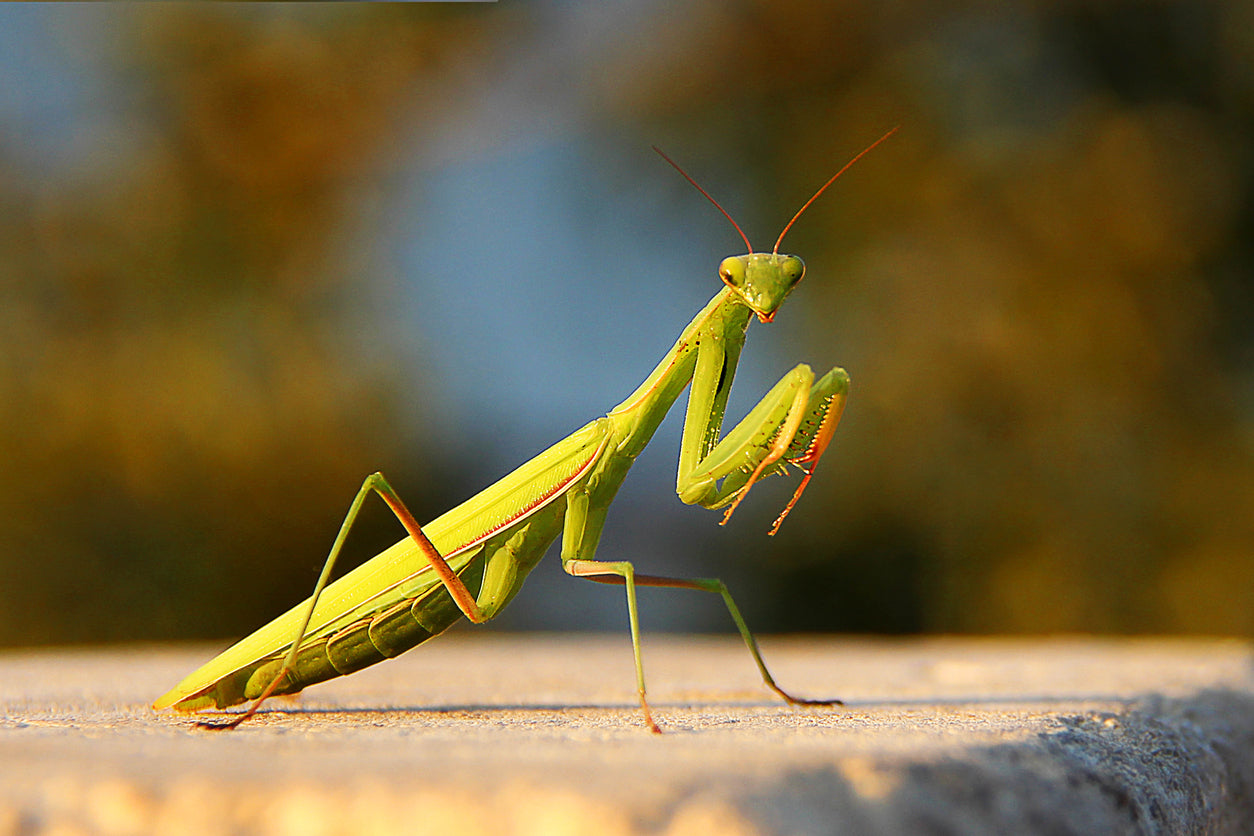
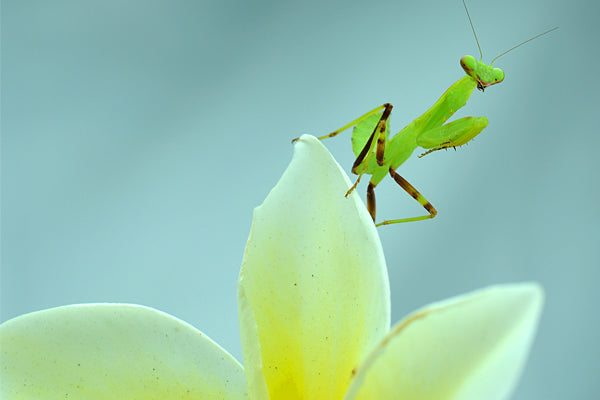
It's tough to see a mantis in the wild! That's because so many have natural camouflage to blend in with their surroundings. The Carolina Mantis has a dull, brown color that makes it perfect for disappearing on the surface of tree bark, while the Chinese Mantis has a bright green color that camouflages against green leaves and other foliage.
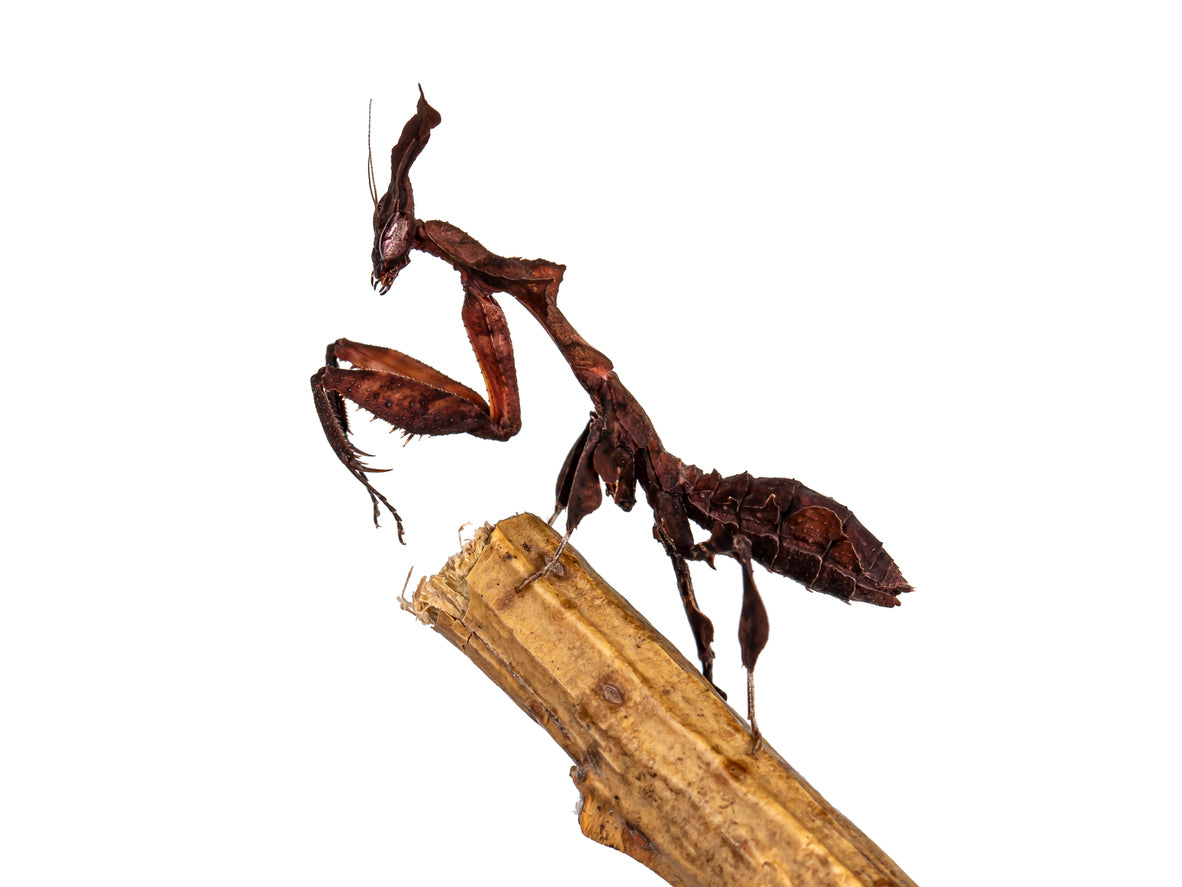
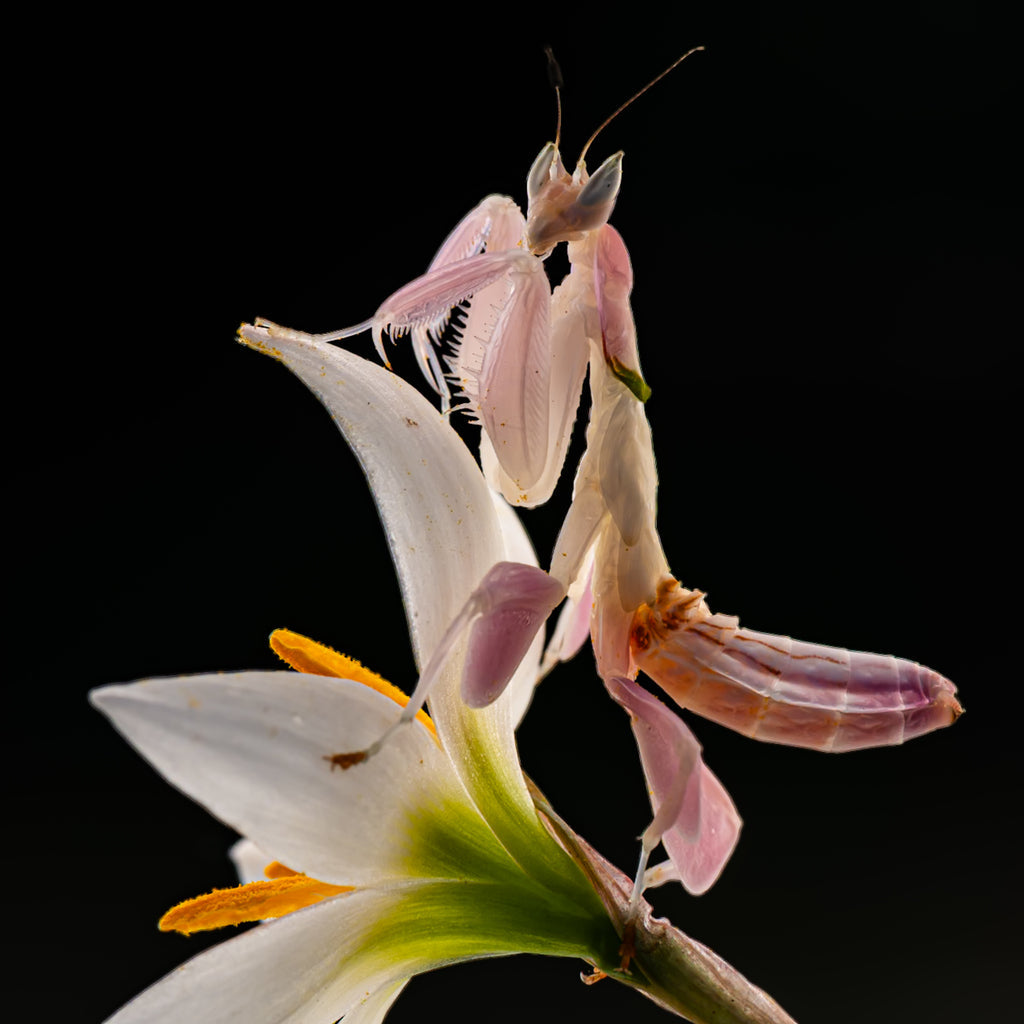
The mantis doesn't just use color to camouflage and disappear: it used the shape of its own body! The Orchid Mantis below looks exactly like the pink orchids it hunts around, and the Dead Leaf Mantis imitates the shape and surface of a dead leaf! Other species will mimic objects such as rocks and twigs to camouflage in the wild.

Staying still can be one of a mantis's best defenses! Most predators rely on motion detection to seek out prey, so keeping quiet and still is key to survival. A mantis that holds perfectly still essentially “drops off the radar! Mantises also use a different kind of threat detection called looming detection. Their visual system is sensitive to rapid expansion in an object’s size, like a shadow or shape growing larger in the field of view. That pattern usually signals an approaching predator. When that “looming” is detected, mantises freeze rather than flee. Freezing preserves their camouflage, especially since their escape options are limited and movement could immediately betray them
When it comes to survival, it pays to be proactive! Now let's see some of the more active ways our mantis friends defend themselves.
The deimatic display in mantises is a sudden, theatrical bluff that turns a normal object, such as a twig, into a startling surprise. The Ghost mantis is a classic example: when threatened at close range, it may spread its forelegs wide, fan out its wings, and reveal contrasting eyespots that resemble a larger creature. The effect is starling and shocking, briefly confusing or even frightening an attacker. Research suggests this behavior is not an early-warning reaction but a last-resort response.
Not all praying mantises can fly, but the ones that can will certainly use it to defend themselves! When concealment fails, winged adult mantises may switch to escape by flight. This is an active, high-energy response rather than a default behavior, triggered only when risk is immediate and other defenses are exhausted. Flight allows rapid relocation away from a predator or disturbance, but it is metabolically costly and therefore used sparingly. Females are generally less likely to fly because their larger, heavier bodies make takeoff slower and sustained flight more demanding compared to males.
The mantis’s defensive system works like an integrated complex platform rather than a set of isolated traits. Its 3D stereoscopic vision gives precise depth judgment, allowing it to detect how close a threat is. A flexible neck enables roughly 180-degree head rotation, letting it track danger without moving its body and disturbing camouflage. If a threat crosses into its range, raptorial forelegs snap forward with calibrated speed and reach. Each of these feature reinforces the others: vision identifies distance, head rotation maintains camouflage while tracking, and forelegs provide the immediate physical strike when escape is no longer an option!
The Praying Mantis isn't the only insect with complex and fascinating behavior! Visit us today to discover more about the endlessly surprising world of insects. Visit our Praying Mantis collection here, or take a peek at our award-winning Butterfly Growing Kits. That's not all: spot some lucky Ladybug Kits to grow your own ladybug friends, or dig into our Ant Kits!

These patient, focused predators have evolved a remarkably dynamic array of physical forms and behaviors. Read on to learn how mantises hunt, camouflage themselves, reproduce, and survive in such diverse environments!

In this article, you'll learn about mantis anatomy, hunting strategies, life cycles, and how to identify common species you might encounter on your outdoor travels.

In this article, you’ll discover the meanings and beliefs associated with the praying mantis across different cultures. You won't believe what you'll discover!

Our insects are sensitive to outdoor temperatures. We recommend ordering when daytime temperatures are below 90 degrees.
We are unable to combine redemption fees. If you are redeeming 1-5 voucher codes, please complete separate purchases through our website for each voucher. If you are redeeming 6+ vouchers, please email us at customerservice@insectlore.com with your voucher codes and shipping address and we'll send you a custom invoice for payment.
You redeemed a $title

Check the Box to Add this Special Offer to your Cart
Check the Box to Add this Special Offer to your Cart