
• Add description, images, menus and links to your mega menu

  • A column with no settings can be used as a spacer

  • Link to your collections, sales and even external links

  • Add up to five columns

  • By Spencer McManamna December 10, 2025 9 min read

    A Guide to Butterfly Migration: Species, Routes, and Navigation

    Butterfly migration is one of the most unique and captivating phenomena in the natural world, involving the seasonal movement of countless butterfly species across vast distances. These journeys, which often span hundreds or even thousands of miles, play an invaluable role in supporting pollination networks and helping healthy ecosystems thrive.

    As butterfly populations are highly sensitive to environmental changes, studying their migratory patterns provides scientists, researchers and casual fans alike insight into habitat health, changes in climate, and the quality of food sources. The more we study how butterflies migrate, the more we create strong conservation strategies, protect key habitats, and ensure the long-term survival of these delicate yet important butterfly friends.

    Read on to learn about the fascinating fundamentals of butterfly migration and why examining these incredible journeys is so important for ecological research and conservation! 

    Do All Butterflies Migrate?

    Butterfly migration is highly specific on a species-byspecies basis. In fact, only a small fraction of the world’s roughly 18,000 butterfly species undertaking long-distance seasonal movements! While iconic migrants like the Monarch (Danaus plexippus), the Painted Lady (Vanessa cardui), and the Red Admiral (Vanessa atalanta) travel impressive and complex distances to track suitable climates and resources, many others remain mostly sedentary throughout their lives.

    Many species, such as the cabbage white (Pieris rapae), the Eastern Tiger Swallowtail (Papilio glaucus), Buckeye (Junonia coenia), do not migrate at all and instead stay within small home ranges where they complete their entire life cycles!

    Why Do Butterflies Migrate?

    Migrating butterflies have a multitude of important reasons to embark on these impressive adventures. Migrating great distances helps butterflies escape freezing winter temperatures and other unfavorable environmental conditions, such as drought or habitat degredation.

    Migratory species seek most of all to travel toward areas with warmer climates, abundant nectar sources, and suitable host plants for their hungry larvae. Migration enhances the chances of butterfly survival, assists in their reproductive success and ensures that future generations will survive and thrive! 

    When Do Butterflies Migrate?

    Our butterfly friends typically begin their migration when their seasonal environmental cues signal that conditions in their current habitat are becoming less favorable, usually in response to changes in temperature, day length, and last but not least the availability of nectar and host plants.

    For many migratory species, this occurs in late summer to early fall, promoting them to move south to escape cold weather, while spring migration begins as temperatures warm and new vegetation emerges. The exact timing varies by species and region! Some start migrating as soon as food resources become scarce, while others rely more on changing temperatures.

    Monarch Butterfly Migration

    The most famous type of butterfly migration is the mass migration of Monarch Butterflies, one of the most recognizable species. 

    Migration Routes

    Monarch butterflies follow some of the most well-defined migration routes in the insect world, traveling thousands of miles between their breeding grounds in North America and their overwintering sites in central Mexico or coastal California. Eastern North American monarchs typically begin their southbound journey in late summer, following a broad flying path that funnels them through the central United States and into Texas before crossing into Mexico. Their flight patterns often involve soaring and gliding on warm air currents to conserve energy, especially during long stretches of their odyssey south. 

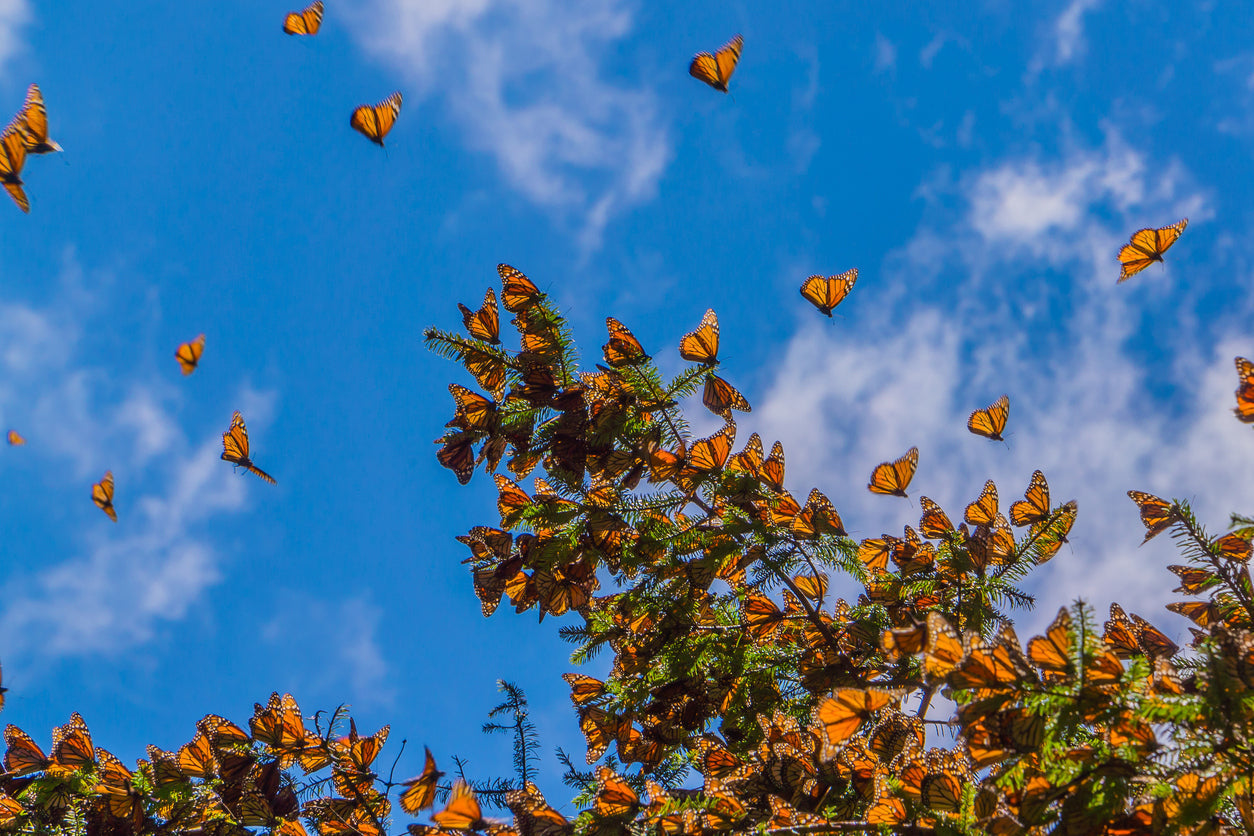
    Along both eastern and western routes, monarchs depend on a network of temporary roosting sites where they gather to rest overnight, often clustering in trees to conserve warmth and reduce predation risk. These roosts can attract dozens, hundreds, or even THOUSANDS of butterflies during peak migration, forming dense, orange-and-black clusters on branches. Clustering behavior helps monarchs maintain their body temperature during cool nights, especially in high elevations and during sudden cold spells. 

    Overwintering Sites

    Monarch butterflies choose to spend the winter in places where the climate provides the cool, stable temperatures and high humidity they need to conserve energy and survive the winter months.

    Eastern monarchs spend the winter in the oyamel fir forests of the Trans-Mexican Volcanic Belt in central Mexico, where dense forest canopies buffer temperature extremes and protect them from frost, wind, and dehydration.

    Western monarchs overwinter along the California coast in groves of eucalyptus, Monterey pine, and cypress trees that create similarly protective conditions through coastal humidity and moderated temperatures. In both regions, monarchs cluster tightly on tree branches in massive groups, which at their largest can number in the millions!

    Our very own Insect Lore explorers traveled to a Monarch migration site in Pismo Beach, CA, where we were lucky enough to catch this incredible sight for ourselves! 

    Navigation

    Monarch butterflies navigate their long migratory journeys using a fascinating combination of environmental cues and innate biological abilities. Their primary tool is an internal mechanism which scientists call a  "time-compensated sun compass". This allows them to use the position of the sun to orient themselves while adjusting for the time of day through an internal circadian clock located in their antennae!

    What happens when sunlight is limited or obscured? When this occurs, monarchs rely on geomagnetic cues that detecting Earth’s magnetic field through specialized molecular receptors to maintain their directional heading. They also respond to temperatures and prevailing wind patterns that help to guide their movement along established flight paths. These incredible navigational abilities help our monarch friends to complete one of the most complex and precise migrations in nature, let alone the insect world.

    Painted Lady Butterfly Migration

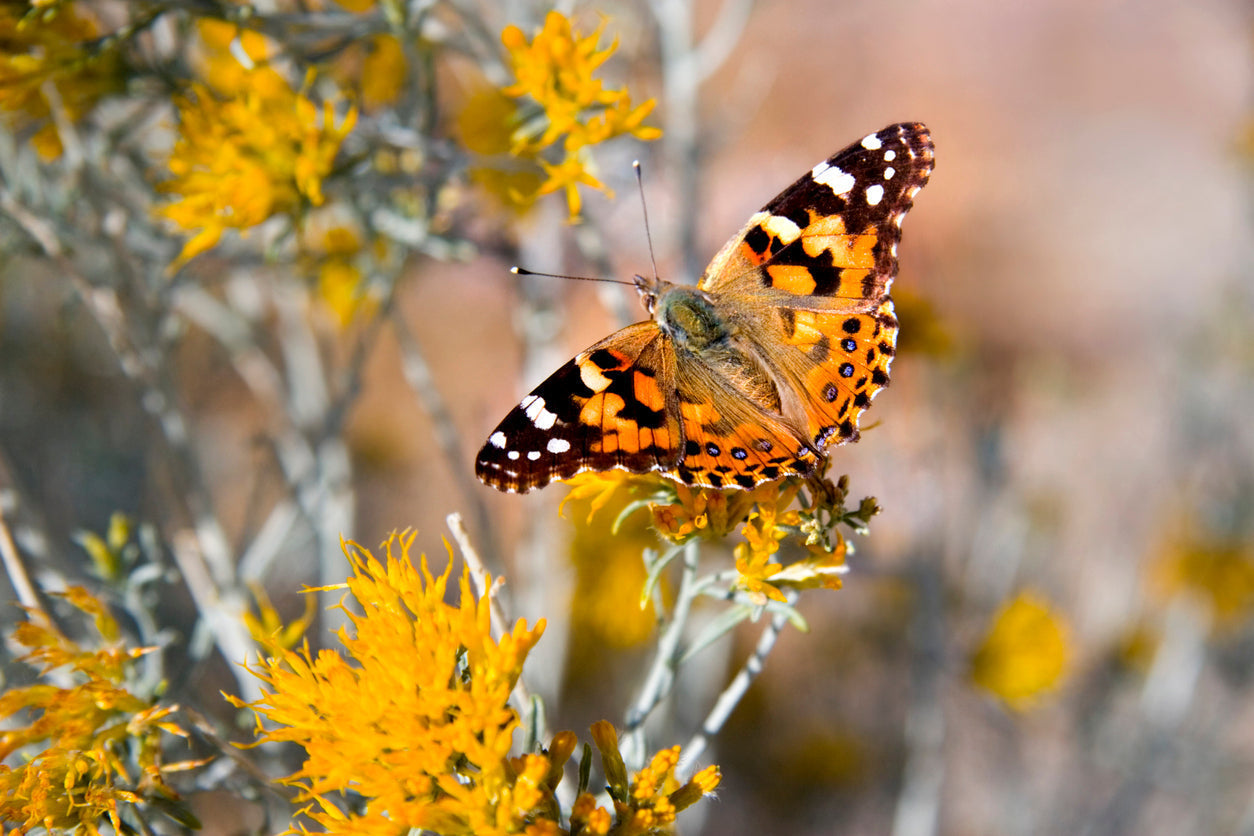
    Our very own Painted Lady butterfly is an experienced traveler, with one of the most unique migration maps in the insect world! Read on to learn just how fierce of a flier these butterflies are, and the incredible places they journey to around our globe.

    Migration Routes

    Painted Lady butterflies (Vanessa cardui) undertake a mind-blowing, multi-generational migration that spans not only continents, but some of the longest distances known among butterflies. In North America, their primary south to north migration begins with adults moving northward from desert regions of northern Mexico and the southwestern United States in spring, following blooming vegetation and favorable winds into the central and northern United States (and sometimes, even southern Canada).

    In the fall, subsequent generations of caterpillars to butterflies move south again, often in immense numbers, riding high-altitude winds that can carry them hundreds of miles in a single day!

    Flight Pattern

    Their flight pattern is fast and direct, characterized by strong, rapid wingbeats rather than the slow, tempered gliding of other species such as Monarchs. Painted Ladies often travel at tremendous heights, allowing them to cover vast expanses with efficient force. In Europe, Africa, and Asia, painted ladies perform an even more dramatic migration, with populations traveling between the Sahel region of Africa and northern Europe in yet another multi-stage, round-trip journey that spans thousands of miles and several butterfly generations.

    Clustering & Roosting Sites

    Painted ladies are less dependent on established roosting sites during migration compared to monarchs, but they will pause to rest and feed in areas that offer lots nectar, sometimes gathering in loose groups.

    Clustering behavior is less noticeable in this species, as instead of forming dense, cold-weather clusters, Painted Ladies like to disperse across vegetation, resting singly or in small groups on shrubs, grasses, or flowering plants. Their reliance on broad habitat types, flexible feeding preferences, and strong flight capabilities enable painted ladies to complete one of the most impressive migrations in nature.

    Overwintering Sites

    Painted Lady butterflies overwinter in warm, low-latitude regions where temperatures remain mild enough to support their survival and continued reproduction. In North America, they spend the winter in the deserts and "scrublands" of northern Mexico and the southwestern United States, where host plants and nectar sources are available through the cooler months.

    Across the Atlantic their major overwintering region lies in the arid and semi-arid zones of North Africa and the Middle East, including the Sahel and surrounding desert margins, which provide the warmth and vegetation necessary for successive generations to thrive - at least, until it is time to migrate once more! 

    Navigation

    While they do not use geomagnetic cues as as well as Monarchs do, Painted Ladies have a variety of flexible navigation skills and strategies. Like many diurnal butterflies, they use the sun as a primary compass, maintaining a consistent flight direction by changing their orientation according to the sun’s position throughout the day. They also respond strongly to prevailing wind patterns, climbing to higher altitudes where fast-moving winds can carry them long distances with a minimal amount of energy used. 

    Red Admiral Butterfly Migration

    The Red Admiral, a member of the Brush-Footed Butterfly family that our own Painted Ladies belong to, are also accomplished migrators. These butterflies love the warm weather, and undergo an incredible journey to keep themselves and their caterpillars from feeling the chill! Read on to discover more:

    Migration Routes

    Red Admiral butterflies have migration routes that are variable and region-specific, often moving seasonally between northern breeding grounds and southern overwintering areas. Red admirals in the northern United States and southern Canada migrate southward in the fall to escape cold temperatures, with some populations reaching the southern United States, Mexico, or the Gulf Coast.

    European populations migrate from northern and central regions to southern Europe, North Africa, and the Mediterranean during winter. Unlike the multi-generational migrations of painted ladies, red admirals often complete longer stretches within a single generation, choosing to fly direct routes while taking advantage of favorable winds. 

    Clustering & Roosting Sites

    During migration, red admirals use temporary roosting sites such as hedgerows, tree branches, and shrubs to rest and conserve energy. They do not form the large, dense overwintering clusters characteristic of monarchs, but may gather in small groups when given shelter from wind and predators. These roosting stops are often chosen for proximity to nectar sources, allowing the butterflies to rest, relax and refuel before continuing their journey. 

    Navigation

    Red Admiral butterflies primarily navigate during migration using a sun compass like the Painted Lady, and are significantly influenced by weather conditions and large visual landmarks. Unlike Painted Lady and Monarch butterflies, they do not use the Earth's magnetic field for orientation: instead, their migratory activity is heavily influenced by weather. They prefer to migrate on days with clear skies and favorable wind directions.

    Unfavorable conditions like strong winds or overcast skies suppress their migratory activity, and when visual cues are blocked (such as during overcast conditions) the butterflies become disoriented and fly randomly. Despite this, they are still skilled enough migrators to complete their journey and continue the success of future generations! 

    Ecological Significance of Migration 

    Butterfly migration has profound ecological significance to our own species and the planet we wish to protect. They are not only valuable environmental indicators, but their migration plays an important role in the pollination and survival plant species. Without butterfly migration, our very ecosystem would be thrown out of balance! 

    Pollination

    As you may already know (especially if you've been fluttering through our butterfly blogs), butterflies play a vital role in pollination, transferring pollen as they feed on nectar from a wide variety of flowering plants. This in turn helps maintain plant reproduction and genetic diversity along a vast amount of species. Their anatomy and feeding habits allow them to reaching flowers that may be less accessible to other insects, and promoting the health of wildflowers, crops, and garden plants alike. Without butterflies, we wouldn't have carrots, apples, sunflowers and more!

    Indicator Species

    Butterflies play the important role of sensitive indicators of environmental health, and speak to the quality of their respective ecosystem. This is because their populations respond quickly to changes in habitat quality, temperature, and food availability! Shifts in their population, distribution, or migratory schedule can reveal the impacts of climate change, habitat loss, and pollution long before these effects become apparent in other  species, whether insect, mammal or more.

    Monitoring butterfly populations provides scientists with valuable insights into ecosystem stability and help us gauge the health of our world! 

    How to Get Involved with Butterfly Conservation

    Want to help our butterfly buddies? You can support butterfly conservation by creating and protecting habitats that provide nectar sources, host plants for caterpillars, and safe migration corridors. Reducing pesticide use, planting native flowers, and maintaining gardens or natural areas that cater to different butterfly species can significantly boost local populations. It can be as easy as creating some "watering sites" for thirsty butterflies in spring or summer, or leaving leaf "litter" on your yard so more insects have a shelter handy!

    You can also look local: sign up for citizen science programs, support conservation organizations, and raise awareness about the importance of butterflies within your own community to help preserve these vital pollinators and ensure the health of the ecosystems they support.

    Explore Butterfly Metamorphosis with Insect Lore

    Ready to witness the incredible journey of the butterfly life cycle? Insect Lore's Butterfly Raising Kits are the perfect choice for any parent looking to give their children a fascinating and life-changing STEM experience. Check out our other Butterfly Blogs here and even take a glimpse of our Pollinator Club to become a pollinator yourself! 

    Ultimate Guide to Pollinators
    Ultimate Guide to Pollinators

    December 15, 2025 8 min read

    Read More
    Tips for Implementing STEM Education in the Elementary Classroom
    Tips for Implementing STEM Education in the Elementary Classroom

    December 11, 2025 4 min read

    Read More
    History of National Pollinator Month
    History of National Pollinator Month

    December 11, 2025 4 min read

    National Pollinator Month, observed every June, is dedicated to raising awareness about the essential role pollinators play in sustaining our ecosystems, agriculture, and global food supplies.

    Read More