

• Add description, images, menus and links to your mega menu

  • A column with no settings can be used as a spacer

  • Link to your collections, sales and even external links

  • Add up to five columns

  • By Spencer McManamna February 04, 2026 3 min read

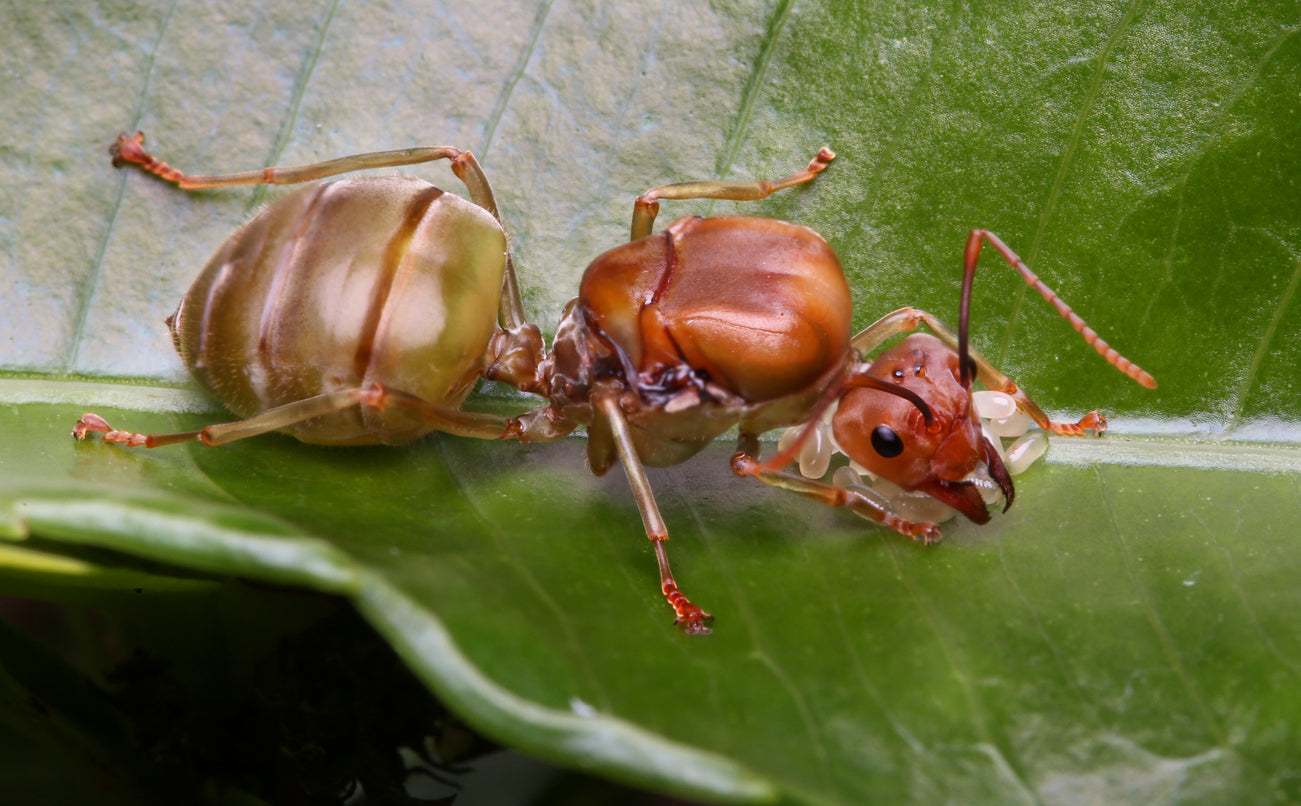
    Though you won't find one in your Insect Lore Ant Hill, Ant Queens are important agents in every wild ant colony! At the heart of every intricate ant colony is the queen, whose survival and reproduction determine the colony’s growth and survival. Join us as we dig deeper into the queen’s role, lifecycle, and influence on colony organization.

    What Does the Queen Ant Do?

    The Queen Ant shoulders many responsibilities, all of which are integral to the ant colony's survival. It's an incredible life cycle that is spent completely underground, hidden from human eyes! Luckily you don't need x-ray vision to learn more about these fascinating royals:

    Mating and Egg Production 

    Queen ants reproduction begins with a romantic "mating flight", during which winged queens and males take to the air to mate. After mating, the queen will shed her wings, and search for a comfortable nesting site. Once settled, she builds a small chamber and begins laying eggs. The hard-working queen will initially care for them herself, using stored energy until worker ants emerge to take over foraging and nest maintenance.

    First Generation Care 

    Imagine caring for a brand new generation of baby ants: what a huge project! The Queen Ant will care for her eggs by grooming them to be clean and protected. Once the larvae hatch, the queen feeds them with nutrient-rich secretions produced by her salivary glands. She also valiantly guards the pupae until they mature.

    Once this first generation of worker ants finally emerges, they assume all caregiving and foraging duties, allowing the queen to get a break and focus her energies on continuous egg-laying.

    Social Organization and Influence

    The Queen Ant's name is no coincidence: she plays the central role in shaping colony hierarchy and stability. Through the constant release of pheromones, the Queen regulates worker behavior and influencing tasks such as foraging, care for young, and colony defense. These chemical signals also maintain social cohesion by reinforcing the colony’s shared identity. The queen also suppresses the development of rival queens by inhibiting reproductive abilities in other females, ensuring her role at the top as the colony’s sole egg-layer.

    A Queen Ant’s Role: Variations Among Species

    Some species of Ant Queen are monogynous, which means that they have a single queen maintaining strict reproductive control. Some others are polygynous, supporting multiple queens that increase colony size. In fire ants, multiple queens accelerate population growth. Army ant queens have the ability to lay thousands of eggs daily, a behavior that drives the rapid, nomadic and "warlike" expansion of their colonies. All of this is happening right beneath our feet! 

    How Does an Ant Become a Queen?

    A Queen Ant has to start somewhere! The biggest factor in determining which ant becomes a queen is simple: it's the one who is fed the most! The ant with the richest diet is the one that becomes bigger than the other ants, eventually triggering a "switch" that makes them become the queen. Their royalty is determined by a combination of genetics, nutrition, and environmental cues such as higher temperatures, rather than choice or behavior on part of the other ants. 

    How Do Ants Pick a Queen?

    "Queen selection” within ant colonies applies in two distinct contexts. First, after a mating flight, a queen independently establishes a new colony without any involvement or choice by workers. Survival depends solely on her ability to build and sustain the nest.

    The second, in established colonies, workers may influence which potential replacement queens are promoted, tolerated, or eliminated, a process sustained by pheromone sharing! 

    Does the Queen Ant Leave the Nest?

    Queen ants are only outside their colony nest for two major stages of their lives: their initial mating flight with a male ant, and then their journey aboveground to find a suitable place to dig and excavate their colony nest! After these initial stages, they spend the rest of their lives underground.

    Once the colony has matured, the queen becomes largely stationary, remaining deep within the nest while workers handle all external tasks and movement. After a TON of work building a home, this Queen has earned her beauty sleep! 

    Explore Ant Colony Behavior with Insect Lore

    Though the Insect Lore Ant Hill does not feature a Queen Ant, it's still an invaluable learning resource and an unforgettable STEM experience. Observe your very own ant community as they explore, communicate and build their very own home. Visit Insect Lore and dig into endless fun today! 

    Harvester ant against a white background.
    The Ultimate Guide to Raising Harvester Ants

    December 01, 2025 10 min read

    Meet the Harvester Ant! This guide will walk you through the process of raising your very own, from setting up your ant farm to feeding, care, and troubleshooting. Whether you’re a teacher running a classroom science project or a parent starting a fun nature activity at home, this is everything you need to know to raise a thriving colony.

    Read More
    Five ants bridging a gap between a leaf and another structure.
    What Ants Can Teach Us About Working Together

    March 19, 2025 6 min read

    Just as ants collaborate, relying on communication and coordination to complete complex tasks, humans thrive when working together, each individual bringing unique skills and perspectives to the table. In this article you will learn all about how ants work together, and what it can teach us about teamwork! 

    Read More
    A lone ant standing on a lead that's floating on blue water.
    How Long Can Ants Live Without Food?

    November 04, 2024 4 min read

    You may know about the wide variety of foods ants like to munch on, but have you ever wondered how long they can go without a meal? The answer may surprise you! If you've got an appetite to learn more, let's dig in.

    Read More